Midweek in late March on a mild evening, I walked up a driveway with my synth in one hand and my camera and audio recorder in the other. I was welcomed inside the home by Chris, who performs under the name Gravemember as a synth musician. He offered to fix my synth for free on a couple of occasions, and wanting a fully functional instrument, I decided to take him up on it. I wasn’t sure what to expect upon entering the home, but was met with the smell of stick incense, low lights, and a place that was, well, home-y.
Last September, I made the somewhat impulsive decision to buy a synthesizer. It all started when I saw a video on Instagram of a cat standing on a white midi keyboard. The video wormed its way into my brain and on one sleepless night, I figured if this cat can make some nice soundscapes just by doing the cat cliché of standing on keyboards, then maybe I could do something as well. I didn’t know how to play the piano, and at the time I still barely knew how to play the guitar that I had for a year at that point (I have since learned my power chords and better strumming technique, please clap), but still managed to convince myself that buying a synthesizer was something I desperately needed to do.
This desire didn’t just come from a cat video, by the way. I have been passively interested in synths for some time now. 2010s dubstep, the FEZ soundtrack, pretty much all 2000s-2010s electronicore, those Touhou black midi videos. The background was there.
Even though this was, I can admit in hindsight, an impulse purchase, I still did my research. I spent a couple days at work when I should have been working looking into the difference between midi keyboards and actual synthesizers as well as analogue versus digital synths. I landed on the Korg Minilogue, which I have come to learn is basically Baby’s First Synth as far as beginner equipment goes. A few video reviews later and I was sold on this thing. A new one would cost me anywhere from $500 to $700–a very serious amount of cash for an impulse purchase. Thankfully, given that this model was nearly 10 years old, there were plenty of used ones on the market, although they were still quite expensive.
I was considering cheaper and older Korg synths when I struck gold on eBay – a Minilogue for just $225. Of course, there was a catch at this price: one of the 37 keys was completely non-functional. However, from the attached video and the seller’s description, it seemed like everything else worked fine. So, I took a chance and dropped very nearly $300 on a hopefully-not-super-broken synth. Eventually, it made it safely to me in a timely manner. And, just like the seller promised, everything worked fine except for that one key. All things considered, I made out like a bandit.
I took it upon myself to open it up and look at what might be the problem. One Reddit thread and a series of Instagram stories later, it appeared the circuitry for that key had corroded somehow. I tried to clean it off with some contact cleaner and rubbing alcohol, but nothing happened. Despite this, I decided to try to learn what I could, mostly just messing around with the presets, having the most fun with the arpeggio and chord voice settings.
Still, that one key not working was kind of lame, and after insisting again on wanting to fix it for me, I decided I would interview Chris in exchange.
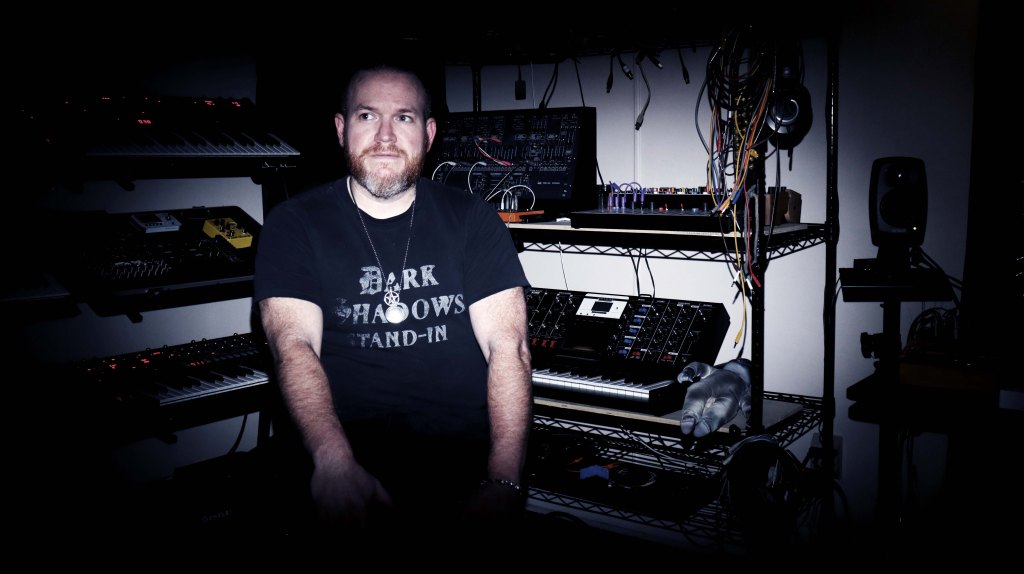
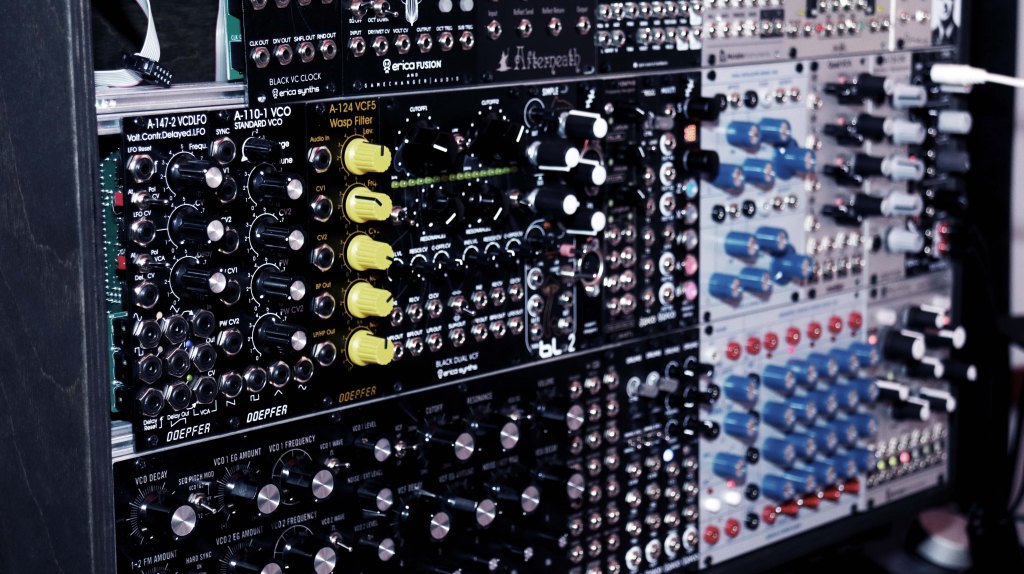
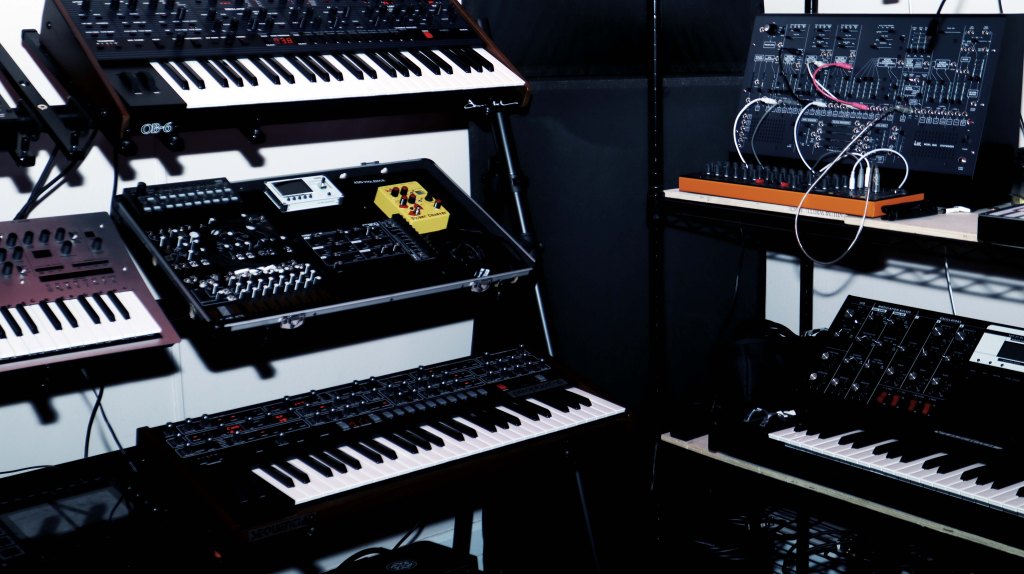
Knobs, buttons, switches, keys, patch cables – that was what I saw when I stepped into Chris’ home studio. So many bits, so many bobs. So many synthesizers! Privately I wondered what it took to amass such a collection, but knew better than to ask. I handed him my Minilogue to look at and he set it on an A-frame stand, diminutive next to the others. Beside all its features, I chose the Minilogue because there is nowhere in my apartment for me to put a full 88-key keyboard. Maybe my bedroom or office, but currently, its home is the far end of my futon in my living room, next to my amp and near my guitar.
He plugged it in and powered it on and started plucking away at the keys, verifying that all but one worked. He asked me if I had created any of my own patches, but I told him no. Yes, I mostly knew how to operate my synth–after all, I spent the days before it arrived excitedly watching Korg’s video manuals–but as he was explaining the different functions, I realized I didn’t know what I was doing after all.
So, how does one find themselves getting into the vast, noisy world of synthesizers? For Chris, the answer is simple: a kid’s toy.
“When I was a kid, I had this stupid old yellow thing, just a stupid kid’s toy. It also had a drum thing on it, you know? The little pads. I was obsessed with it as a kid. Then I guess it broke or something.” From there, he moved on to guitars, but the fascination remained.
“I can’t tell you how many delay pedals I had, or putting the compressor on the delay and cutting the feedback all the way up and using the compressor to not get it out of control, tame the chaos. I’m not really a guitar player, you know? I find myself gravitating to [synths] or making my own things. I will play, but I’m not as good as some of these other guys. Let me just stick with what I know.”
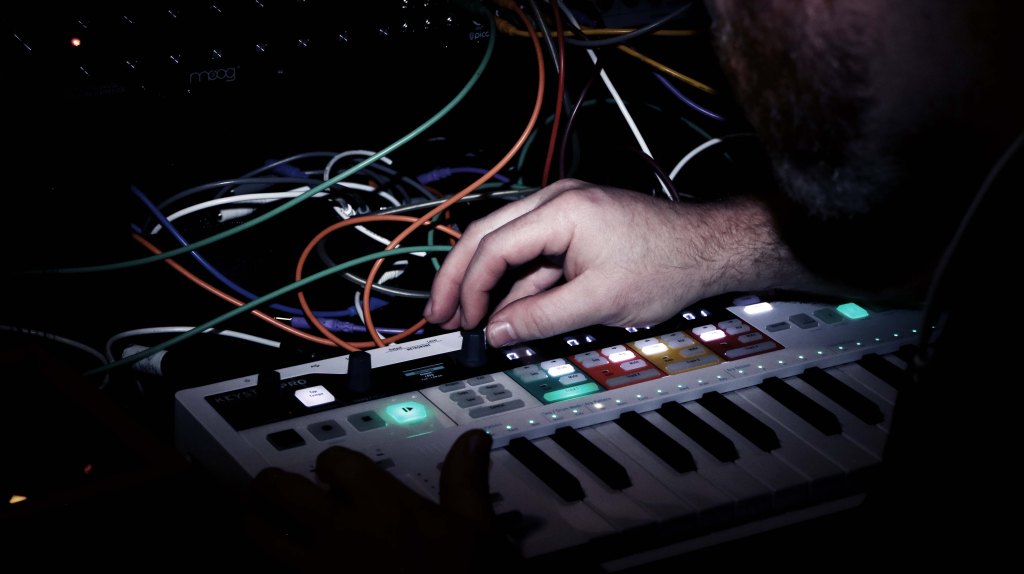
I first saw Chris perform as Gravemember back in May of 2024 alongside Plagueburner and Measureless Aeons, his first time performing live with the project. I didn’t quite know what to expect from it. At the time, I don’t think I had ever seen anyone perform with a modular synth live. I remember being deeply mesmerized by it all, all those knobs and switches and patch cables creating loops that almost hypnotized me. I remember wanting to be enveloped by that wall of sound in a sensory deprivation chamber.
Chris’ music can be described as experimental, industrial (though he doesn’t necessarily agree with that descriptor), metal, rock, noise, dark ambient, and electro-pop, depending on the song. “Industrial metal is what a lot of it is referred to as. Or noise. I do a little bit of both. It’s hard to classify, you know? I don’t wanna classify it because I don’t wanna be like this or be like that. I want to do my own thing, come up with something new to keep it interesting.”
Although I’ve only been covering the goings-ons of the underground music scene here in Jackson for a very short two years, it seems synth-focused music and, by extension, noise, is something that is starting to gain a larger foothold in our musical landscape. We have plenty of rock shows, a handful of hardcore, a smattering of punk. The tastes of a scene of course ebb and flow. Noise and experimental artists seem to have always found their ways onto mixed bills opening for hardcore and punk bands, but now it seems we’re getting more shows dedicated to it. One such show was profiled in Mississippi Today (which I was interviewed for). While it does frame noise as being a bigger part of Jackson’s music scene than it probably is, what it succeeds in showing is that there are a not insignificant amount of people in our scene who are really drawn to it – myself included.
“If it weren’t for you, I wouldn’t have done any of it, for the most part,” Chris said when I asked how the music he makes fits into the underground scene in Jackson, “You’ve been a catalyst.” I’ve heard this from him on more than one occasion, and while there is a time and place to fellate myself in print, I don’t think I necessarily agree here. I didn’t put that first show on, someone else did. People have had noise and synth projects long before I got here and they will continue to have them long after I leave. But maybe I am underestimating my influence a little.
When I was booking shows, I did want to book more noise and synth, but mostly for selfish reasons: I liked it, and I wanted to see more of it live. I managed to organize one decently attended one with Jenn Taiga, Filth Eternal, and Chris as Gravemember in July of 2025. But before that, I was set to put on a noise show that January that I made the decision to cancel because of incoming weather that didn’t even end up being that bad (which I felt bad about for several months afterward). For that show, I wanted to have him perform, but couldn’t get in contact with him. I asked around, was told he couldn’t, and that was that. He intimated to me that was maybe the reason for him to continue performing. Either way, I still think my part in that was very minor.
It’s no surprise to me his music imprinted upon me so much. Some of my favorite films that I’ve seen are my favorites in large part because of their soundtracks, from the big sweeping scores in 2021’s Dune to the subdued jazz of A Thousand and One. In a way, his music is cinematic, which makes sense – he composed the score for the short film Mean Spirited executive produced by Kat Axtell in 2018. “I was doing that thing where I would post on Instagram some stupid reel or stupid story of myself playing a synth. And she was like, ‘Oh, that sounds really cool! We’re about to do a film, do you wanna do the music for it?’ And I was like, hell yeah! Are you kidding? Absolutely! It was about the time I got the Rev2 Prophet, I think it was 16 voice at the time. I got the footage, and it was like, hey this is kinda cool. This is fun!”
He continued, “I love film scores, I think they’re amazing. I’ve always been inspired by Trent Reznor and Atticus Ross. Gone Girl, The Social Network, and all that stuff, that’s what inspired me.”
He said he also plans to revisit the score for the short film and release it someday, and expressed interest in doing more film scores. “I love doing scores. It’s probably one of the most fun, challenging things to do. To get it done, it puts a little bit of pressure on you. I think if I were to do it, I would want more collaboration with either the director or whoever’s doing the film. That kind of dedication and time is what I would really like. That collaboration makes something truly good, in my opinion.”
Aside from his synth work, he has also recently started doing vocals for Vicksburg band Plagueburner. It actually all started during that very first show in 2024. “I got to talking with them. About a year later, we just kind of talked on and off here and there. I think Mikey [vocalist of Plagueburner and False Gods] was going back to New York, and he’s like, ‘Have you ever done metal vocals?’ And like, I have, but I don’t know if I can compete with Mikey. It’s been challenging trying to learn someone else’s lyrics.”
This, however, isn’t his first foray into vocals, or being in a band. “I was out of Hattiesburg. I met these guys years ago, 2002. Rich Anderson, Josh Anderson. They had this band called Candlelit Dinner. The metal scene at that time was so cool, there were so many bands playing.” Eventually, he and the members of the band moved to Austin to make music in the live music capital of the world. But the dream was short-lived when the rest of the band moved back to Mississippi after just a few months and Chris stayed in Texas for a few years before moving back as well. He wanted to restart things, and the name Gravemember was born. But again, it didn’t work out. So, he took the name and started doing his own thing with it.
After Texas, he occupied a practice space on West street in Jackson in a building occupied by several bands at the time, some of who were living out of the practice spaces – including Chris for a few weeks. “It wasn’t that fun, but that was a cool little spot. I know JD and them [of Jackson band Kicking] have that space. It’s nice to be able to have a place to practice. I don’t think people realize that you can find cheap spaces and actually go rent them and jam.” Originally from Mendenhall, after the Texas stint and moving around for work for a few years, Chris has been in Jackson for roughly 10 years.
I asked how he though the music he made fit into Jackson’s underground music landscape. “To be honest with you, for many years, I didn’t want to ‘fit in’ here at all. I completely abandoned the idea of it because I thought nobody was doing what I was doing. I was wrong about that. There are a lot of people out there that are. Community-wise, I can now go out and be supportive of people that are doing the same thing, and hopefully inspire them to do the same thing. Just in the few times I’ve played, I’ve had multiple people come up to me and talk to me and go, ‘I didn’t know anybody could do that!’. I didn’t either. Inspiring other people that are afraid to try to pursue anything, I think, is where I fit in. It’s okay to mess up. It’s okay to forget lyrics. It’s okay to do all those things. I think it’s about being humble, not taking things too seriously, and also having fun. Make some music, who cares? Somebody’s gonna like it.”
There’s also a level of altruism in how Chris engages with the community. “I was talking to Gary [owner of the Patton House and Gallery in Jackson, a new venue for shows], like you’ve got a lot of cool history here. That’s a big deal. When I was looking him up, I couldn’t find a website. I was like, I’ll build it for you. Just something quick. I’ll do it for free. This is just helping the community. I’m not looking at money, who cares about that?”
Helping others achieve greatness is ultimately where he though he fit in. “I will give somebody something to get them on that journey. Sometimes it’s turned out good, sometimes it’s not.”
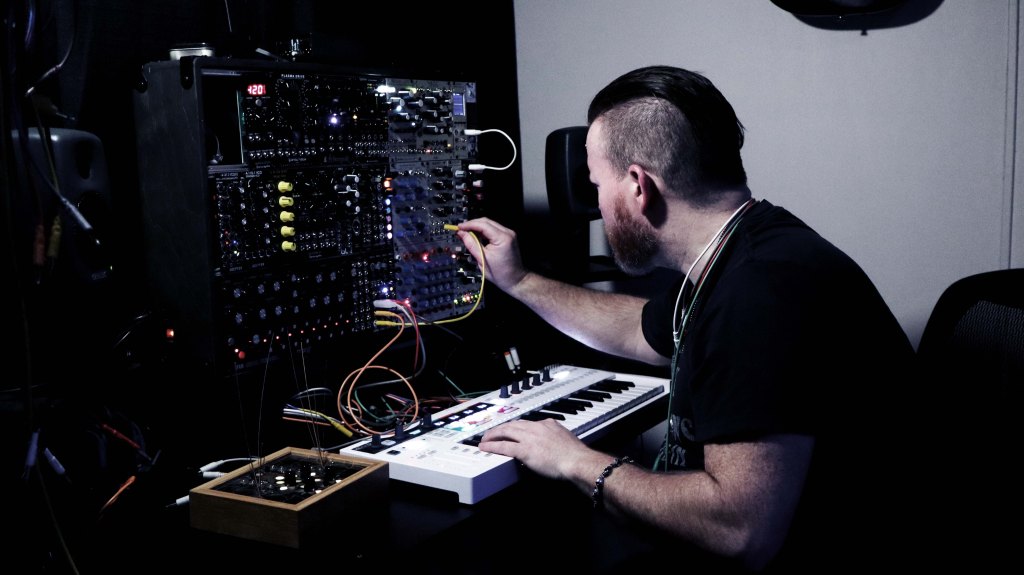
I asked whether Chris felt like synth music had become unconventional in the underground music space. After all, there was a time when every up-and-coming metalcore band had a synth player: The Devil Wears Prada, Attack Attack!, Horse The Band, I See Stars. Okay, maybe not every band, but it did feel overrepresented. Now, though? It seems the kids are picking up 7-string Ibanezes instead of microKORGs. “Sure, I guess you could say it is, kinda, maybe, sorta unconventional. If you had a whole band, it was normal to see a keyboard player. If you didn’t have one, you could do it all from a box. I could do it from that drum machine,” he said, pointing to an Akai MPC Live. He added, “It seems a little boring, you know? I don’t wanna just get up there and hit play, you gotta perform it, do something with it.”
“It’s starting to become more conventional. Years ago, you’d see it in bigger cities, but now, it’s starting to become pretty common. I think it’s a great thing, to be honest. It allows people to go out and do something, not just stuck in the house doing nothing. Get out and do whatever. Who cares? As long as you’re having fun.”
After reading this, you might want to get into the world of synth music. Maybe this article will worm its way into your brain like that cat video did. Maybe you’ll start to look up synths and be put off by these instruments that often are hundreds if not thousands of dollars. But you don’t have to be. “Anything that makes a noise is pretty much a synthesizer, right?” Chris said. There are plenty of tutorials on the net for how to make noise boxes that mostly involve drilling holes into Altoids tins and filling them with rocks and screws and affixing a guitar pickup. But maybe you want something more musical.
“The Minilogue is a great entry-level synth. There’s a lot of cool features that thing has. If you don’t want to spend too much money, Moog has this kit you can buy,” he said, retrieving a compact analog synth from a shelf, “I can’t remember how much they were. Two, three hundred bucks? You build it yourself. And now I have a full synthesizer with oscillators and filters, envelope generators. Then I can jump out of it, so now it’s kind of like a modular synth as well. You can get a little sequencer for a hundred bucks. Anything like that would be a good entry-level.” The kit he mentioned, the Moog Mavis, comes in parts like a Raspberry Pi or Arduino and retails for about $300. He didn’t mention this, but I will: there is also nothing wrong with buying secondhand. You can get something perfectly good (or mostly good, in my case) at a decent discount. And while this is heavily location-dependent–I don’t think there are many people in the Metro offloading their old gear at Goodwill–you just might have luck at a thrift store.
“If you don’t have any money, just software synths. They’re plentiful, you can get them for free. Hell, you can even get Eurorack software for free. You can download any module that’s out there, and you can wire it up just by clicking.” I’m not sure if he meant free as in open-source or free as in sailing the seven seas, but I’m a big proponent of either. If I could figure out how to torrent at 12, you probably could as well.
“I’d say probably start with a software synth to get the idea if you don’t have any money. But if you put a little money into it, I would say get something that would inspire you to play. Because it matters what it feels like, what it sounds like. The Moog Voyager, that’s a vintage synth now, it’s got a vibe to it. All those big knobs and the paint on the side of the wood, you know, all these things have a whole vibe to it. When you turn the filter, it’s like oh shit, that sounds awesome! A lot of people don’t realize until they put their hands on one of these things that oh, that’s what it does. Just any basic synth, I would say start with that.”
After our interview, which lasted for about an hour, we spent another 45 minutes or so just fiddling around with the rest of Chris’ gear. And yeah, it really is fun to just get your hands on an instrument and play around with it. Addicting, almost. Like I said, I don’t know how to play the piano, but I know one chord as well as the four note motif from the album Danza IIII: The Alpha – The Omega, and just doing that over and over again was surprisingly fun. As of writing, my synth is still “in the shop”, so to speak, but when I get it back (hopefully with a repaired key), I want to see what I can do to record on my computer. Not promising any recordings or performances at any point in the future, but I want to be able to record something that resembles a song, if for no one but myself.
I didn’t know where to fit this in the rest of the article, but the beginning of my interview recording is about 23 minutes of Chris improvising on various synths while explaining them, including the modular. I thought it was interesting, so I’ll include the audio here.
 JXN UNDERGROUND